Every Client Is Your Teacher
Jul 30, 2026Every client that walks through the door is teaching you something. Every patient is too.
The question is whether you are paying attention.
Most of us were trained to see appointments as problems to solve. Diagnose, treat, discharge, repeat. That cycle is the engine of a clinic and I understand why it exists — there is a schedule to keep, a team to manage, a waiting room full of people who drove thirty minutes to be here. The pace is relentless.
But the most skilled clinicians I have ever worked with do not operate purely inside that cycle. They do something different, almost imperceptibly, at the end of every case. They pause. They extract something from the appointment before they move on to the next one. They treat every single case as a data point in a lifelong education, not just a task to complete.
That distinction — between surviving your caseload and learning from it — is one of the most important things I have come to understand about this profession.
The Pace Does Something to Us
The pace of veterinary practice is not neutral. It does not just make us tired. It actively shapes how we see our work.
When you are moving from room to room with five minutes between appointments, your brain optimizes for throughput. It has to. You are triaging, prioritizing, making rapid decisions, and moving on. That is a real and necessary skill. But there is a cost to it that we do not talk about enough.
Appointments start to blur together. Not because you stop caring — most of the vets I know care deeply, sometimes to the point of exhaustion — but because the pace removes the space where meaning gets made. When you are always moving to the next thing, you never fully absorb the thing you just did.
That is what I mean when I say the pace of practice turns every appointment into a transaction. It is not a character flaw. It is a structural problem. And it is one of the primary drivers of the kind of burnout that does not look like burnout from the outside — the kind where you are still showing up, still doing the work, still technically fine, but something has gone quiet inside you that used to be loud.
The vets who burn out are often the ones who stop seeing this work as the privilege it is. Not because they stop caring. But because the pace stripped away the space where that sense of meaning lives.
The One Question
I want to offer you something small. Not a system. Not a protocol. Not another thing to add to your already full plate.
Just one question.
At the end of every appointment — before you move to the next room, before you get pulled into a conversation with a tech, before the next chart opens — ask yourself:
What is the one thing from this case that makes me a better vet?
That is it. One thing. Not five. Not a full debrief. Just one.
It could be a clinical finding you had never seen before. A presentation that surprised you. A lab value that made you rethink your differential. A physical exam finding you almost missed and caught at the last second. Those moments are gold, and they happen more often than we register when we are moving fast.
It could be a communication technique that actually worked. A way of framing a difficult conversation about cost that landed with a client instead of creating tension. A question you asked that opened something up. Communication is a clinical skill, and we get better at it the same way we get better at everything else — by noticing what works and what does not.
It could be a mistake you are never going to repeat. We have a complicated relationship with our mistakes in this profession. We are trained toward perfectionism and we carry the weight of outcomes in a way that is real and serious. But a mistake you are conscious of is a mistake you can learn from. Naming it — even just to yourself, even just for a moment — is not weakness. It is how you grow.
And sometimes the one thing is not clinical at all. Sometimes it is a client who quietly taught you something about patience. Sometimes it is a pet owner who asked a question that made you realize you had been explaining something in a way that was not landing. Sometimes it is just watching an animal trust someone in a way that reminds you why you chose this work in the first place.
One thing. That is all.
The Math
Here is what I want you to sit with for a moment.
One insight per appointment. Ten appointments a day. Five days a week.
That is fifty growth moments every single week.
Over a year, that is 2,600 growth moments. Not in a conference room. Not in a CE seminar you drove four hours to attend. In your clinic, in your exam rooms, with your actual patients and clients, doing the work you are already doing.
That is not really a career. That is a master class every single year.
The vets I have known who have been in practice for twenty or thirty years and are still genuinely curious — still lit up by a tricky case, still growing — they are not superhuman. They did not have easier careers or lighter caseloads. What they had was a practice of extraction. They were always pulling something out of the work. Always asking, even quietly, what this case was trying to teach them.
That is the difference between twenty years of experience and one year of experience repeated twenty times.
The raw material for becoming an extraordinary clinician is already in front of you, every single day. You do not need more cases. You need a different relationship with the cases you already have.
One Question Can Change That
Veterinary medicine is a privilege. I mean that without a trace of irony. We get to learn from living patients every single day. We get to be trusted with the animals that people love most. We get to apply science and intuition and experience in real time, in ways that matter.
When every appointment is a transaction, that privilege disappears. You are just processing. And processing, day after day, year after year, without the counterweight of growth and meaning, is a recipe for the kind of exhaustion that does not respond to a vacation.
One question. One insight. Fifty growth moments a week. 2,600 a year.
That is a master class. And you are already enrolled.
Save this. Come back to it on a hard day. And end your next shift with intention.
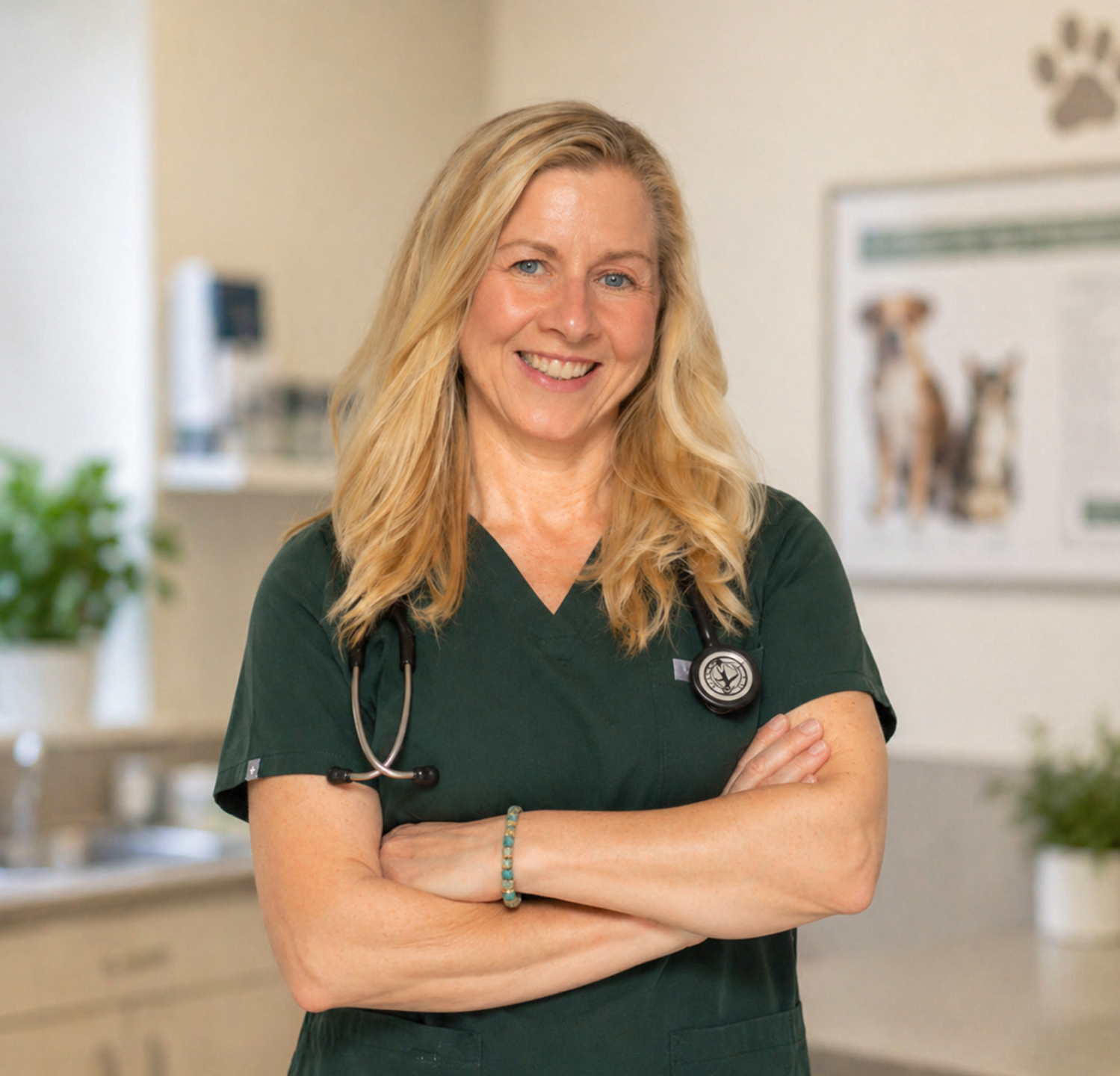
Dr. Melissa Magnuson, DVM
Founder of The Conscious Vet and Conscious Vet Pro, owner of three AAHA-accredited hospitals in New Hampshire, and creator of the Conscious Care™ system. A Director of AAHA and AVMA speaker, she has spent 28 years in practice mentoring more than 30 veterinarians and currently works directly with 17 vets on clinical decision-making, exam room communication, and leadership.
Want the toolkit that helps you show up with more clarity and confidence in the exam room?
Get The Overwhelm Exit