
What Animals Know About Presence
May 26, 2026Originally published on The Conscious Vet Substack. Subscribe for weekly essays at theconsciousvet.substack.com.
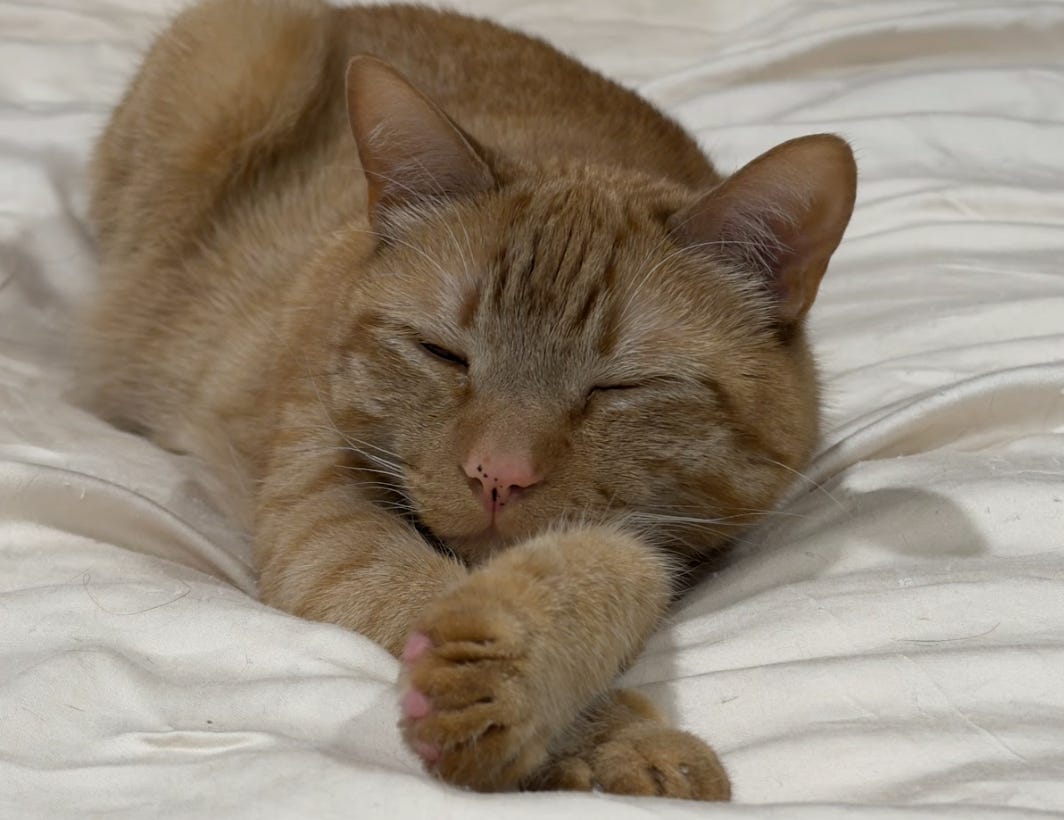
My cat is stretched across my bed on a thick blanket, one paw tucked under himself like he has nowhere else to be and no urgency to become anything other than exactly what he is in that moment. His eyes are half closed. Not asleep. Not fully awake either. If I say his name, one ear flicks immediately toward me and his eyes open softly. He starts to purr.
Not the dramatic purring people often notice when they pet a cat. This is quieter. Rhythmic. Steady. A low-frequency hum that seems to settle into the room itself.
And every time I watch him like this, I think the same thing:
I think cats meditate.
Not in the human sense of apps, timers, or guided breathing. But in the sense of complete presence. Calm awareness. Rest without disappearance. A body and mind settled into the exact moment they are in.
What Animals Show Us in Stillness
The more years I spend observing animals, the more convinced I become that many species enter this state regularly.
Dogs do it too. You call their name from another room and they lift their head immediately from the couch, eyes soft but attentive. They were resting, but not disconnected. Their bodies were loose, breathing slow, fully relaxed, but still available to the world around them.
Rabbits sprawled out luxuriously on their sides show it in a different way. Guinea pigs flatten themselves into fleece beds with complete trust in their environment. Birds perch quietly with feathers slightly puffed, eyes half mast, appearing to stare into nothing at all while remaining capable of responding instantly to movement or sound.
I watch this all day in exam rooms, treatment areas, hospital cages, and homes. Animals communicate constantly through how they hold themselves in space. Tension tells me things. Hypervigilance tells me things. Withdrawal tells me things.
But peace tells me things too.
The animals who are comfortable enough to settle into themselves carry a kind of clarity that is difficult to describe unless you’ve spent years watching for it. There is an ease to them. They are not checked out. They are not lazy. They are fully present.
And honestly, there is very little more joyful than witnessing a creature that feels safe enough to simply be.
Rest Is Not Doing Nothing
We often misunderstand these moments because humans tend to equate stillness with inactivity. We see a dog lying quietly near us and assume he is “doing nothing.” We joke that cats sleep all day. We interpret rest as disengagement.
But I don’t think that’s what’s happening.
I think many animals are recharging in a way humans have largely forgotten how to do.
The Sound of Regulation
Purring fascinated me for this reason long before I ever thought about meditation. Scientifically, we define purring as a low-frequency vibrating sound cats use to communicate emotional states. Most commonly, we associate it with contentment. But cats also purr when they are stressed, fearful, injured, or trying to self-soothe.
That detail matters.
Meditation in humans is not the absence of feeling. It is not shutting thoughts off or achieving permanent calm. It is the practice of returning to awareness without judgment. Training attention. Regulating the nervous system. Creating steadiness.
When I listen to a cat purring quietly while resting in complete presence, I can’t help but hear something familiar in that rhythm.
Not identical to human meditation, of course. Animals are not tiny furry philosophers sitting cross-legged contemplating existence. But they may understand something instinctively that we complicate unnecessarily: the body needs moments of calm attentiveness in order to recover, reconnect, and remain regulated.
When Animals Cannot Settle
The problem is that humans often misunderstand rest in both animals and ourselves.
Owners will tell me their dog “just sleeps all day,” but when I ask more questions, I find a dog deeply attuned to the household. A dog who notices every movement, every shift in tone, every routine. A dog who rests deeply because he feels safe enough to do so.
Or I see the opposite. Animals who cannot settle. Dogs pacing constantly. Cats hiding but never truly relaxing. Birds remaining hyper-alert in environments that never allow decompression. Rabbits whose muscles stay tight because their nervous systems never fully exhale.
Animals show us very clearly what chronic stress looks like when presence disappears.
And humans are not very different.
What This Has Changed in My Practice
I think this has changed the way I practice medicine more than people realize. Over time, I’ve become less interested in simply whether an animal is eating, drinking, or sleeping and more interested in whether they are capable of settling. Can they rest deeply? Can they exist calmly in their environment? Can they recover after stress?
Because healing is not just physical.
A nervous system that never feels safe struggles to heal well.
I also ask owners different questions now. Not just “How active is your pet?” but “When do they seem most at peace?” I pay attention to where they choose to rest, how quickly they startle, whether they can remain relaxed while still connected to the world around them.
Those observations often tell me more than diagnostics alone.
The Wisdom Animals Model Every Day
What I wish more pet owners understood is that animals are constantly modeling something we desperately need ourselves.
Observation without judgment.
Presence without performance.
Rest without guilt.
Most animals do not spend their lives fighting every passing thought or trying to optimize every second of the day. When they feel safe, they settle naturally into the moment in front of them.
Humans resist this constantly. We fill silence immediately. We multitask through conversations. We struggle to sit still without reaching for stimulation. Even rest becomes something we try to accomplish efficiently.
And yet some of the healthiest moments I witness every week involve an animal doing absolutely nothing except existing comfortably in its own body.
There is wisdom in that.
I am not suggesting we abandon ambition or responsibility and spend our lives stretched across blankets in sunbeams. But I do think we would all benefit from relearning how to be present without demanding productivity from ourselves every second.
To observe more.
To judge less.
To allow stillness to be restorative instead of suspicious.
Simply Being There
“Remember the blue sky. It may at times be obscured by clouds, but it is always there.” — Andy Puddicombe, Headspace co-founder
Animals seem to understand this instinctively. Beneath stress, fear, overstimulation, and illness, there is often still a capacity for calm waiting to return once safety returns.
Maybe that is part of what I feel when I watch my cat purring softly with his eyes half closed.
Not sleep exactly.
Not performance.
Just presence.
And maybe the lesson isn’t that animals meditate like we do.
Maybe it’s that they never forgot how to simply be there at all.

Dr. Melissa Magnuson, DVM
Dr. Melissa Magnuson is the founder of The Conscious Vet and owner of three AAHA-accredited veterinary hospitals in New Hampshire. With 28 years of experience caring for pets and the people who love them, she is passionate about helping pet owners better understand their animals, navigate difficult decisions, and feel more confident about their pet's health and well-being.
Want more stories like this? Subscribe to The Conscious Vet on Substack for weekly essays on pets, veterinary medicine, and the bond between animals and the people who love them.


