
A Tiger Let a Vet Draw His Blood
Jul 28, 2026Originally published on The Conscious Vet Substack. Subscribe for weekly essays at theconsciousvet.substack.com.
What a Disney tiger, a terrified French Bulldog, and my biting Chihuahua taught me about preparation, trust, and the hardest form of love.
Lessons Across Species Series
I was sitting in a keynote at the AVMA conference when a photograph made me lean over to my colleague and say — out loud, in a room full of veterinarians — “I am not sure I would feel comfortable doing that.”
The speaker was Dr. Mark Penning, who spent 14 years as Vice President of Animals, Science, and Environment for Disney Experiences before becoming Director of the North Carolina Zoo. And the photograph was a tiger.
Not sedated. Not behind thick glass. A full-grown tiger, awake and calm, lapping goat’s milk through one end of a small open-sided cage while a veterinarian drew blood from his tail at the other end.
My colleague looked at the same photo and felt the same thing I did.
Amazing. And also — no thank you.
But that image did not leave me. Because what I was looking at was not a trick. It was not showmanship. It was the result of someone taking the time to teach that tiger what care would feel like before care was needed. The goat’s milk was not a bribe. It was a conversation. A shared language built over hundreds of repetitions until the tiger understood — this is safe, this is predictable, and something good comes from staying still.
I kept thinking about that tiger for the rest of the conference. And then I started thinking about French Bulldogs.
What Happens When Trust Was Never Taught
If you want to understand what the absence of preparation looks like, spend a day in a veterinary hospital with a Frenchie who has never been taught to accept handling.
We have several. I love them. They also represent some of the most difficult appointments we manage.
Here is what that visit looks like.
The dog arrives already terrified. The owner, who loves this dog genuinely and completely, has often been unable to give the pre-visit medication we prescribed because the dog won’t take it — not even hidden in food, not even from the person he trusts most. So he arrives at full anxiety, no chemical help on board, remembering every previous visit and prepared to fight.
We cannot muzzle him. The flat face makes that impossible. So we place an e-collar around a lunging, panicking dog, which is exactly as stressful as it sounds for everyone in the room including the dog. Then an injection to start sedation while someone holds him wrapped in a blanket so no one is injured. Then we wait. Then finally — sedated — we move quickly through everything we need to do. Exam, nails, ears, whatever brought him in.
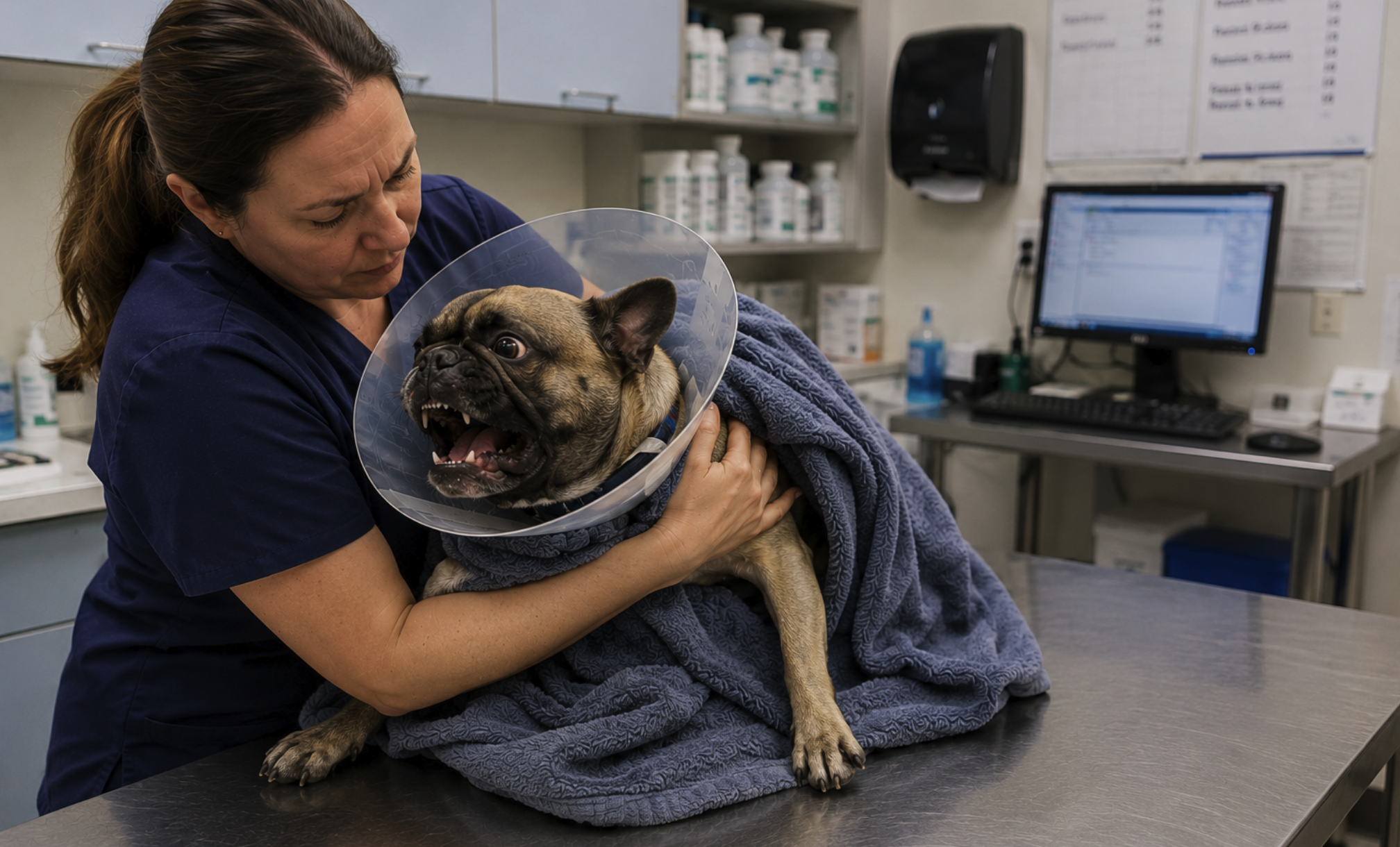
Then we reverse the sedation.
And he wakes up remembering.
Next time he comes back, he has not for
gotten. He has upgraded, except the upgrade isn’t for the better. Each visit builds on the last, and not in the direction we want.
That dog is not bad. He is not aggressive. He is a dog who was never taught that human hands could mean something other than threat or surprise. And now we are trying to build that trust in the middle of a crisis, every single time, with the clock running and a team bracing.
It is not fun for anyone. Least of all him.
Behavior Is Built One Repetition at a Time
I want to be clear that I am not exempt from this conversation.
My Chihuahua came to us biting. She had been surrendered to the hospital because she bit everyone in her previous home. When she arrived in mine, she tried to bite everyone in that one too.
For the first six months, it was not easy. She wanted to continue doing what had worked for her. Biting was her solution. It had always created distance, and distance had always felt safer.
But we kept working. Slow, consistent, repetitive. Touch predicts good things. Stillness predicts good things. We built the language from the ground up.
Six months later, she was a different dog. Not a different personality — still a Chihuahua, still opinionated, still certain she is the most important creature in any room. But cooperative. Accepting of a full exam. Mouth, ears, nails, temperature, blood draw. All of it.
Six months of work to undo six months of learned behavior.
That is not a coincidence. That is how behavior works. It took exactly as long to fix as it took to build. And the only reason it got fixed is because someone decided the investment was worth making.
Love Is Not Preparation
Here is the line I find myself saying to clients more and more.
Love is not preparation.
A pet can be deeply, genuinely loved and still be completely unprepared for the world they live in. They can sleep in the bed, eat the best food, have a wardrobe, receive more affection than most humans, and still have no idea how to cooperate with basic care. Still panic at the vet. Still bite when touched. Still fall apart when the routine changes.
That is not a character flaw in the pet. It is a gap in communication. And once we name it that way, we can do something about it.
I also tell clients this: love comes in many forms, and not all of them serve the animal.
Some people love their pets with food. Those pets are overweight.
Some people love their pets with constant attention and no structure. Those pets have anxiety and behavior problems because they have never learned to exist independently or to tolerate frustration.
And some people love their pets by doing the work — the repetitive, unglamorous, sometimes frustrating work of teaching an animal what is safe, what is expected, and what comes next.
That last one is the hardest form of love to sell. It does not feel like love in the moment. It feels like discipline. It feels like saying no. It feels like holding a boundary when the dog is staring at you with those eyes.
But children thrive with structure. They need it. They feel safer with it. And so do animals. Not because structure means control for its own sake — but because a clear, consistent environment tells an animal that someone is paying attention. Someone is in charge. They do not have to figure it out alone.
That is not dominance. That is leadership. And it is one of the most practical things an owner can offer.
Care Before It’s Needed
I keep coming back to that tiger.
Not because every dog and cat should be trained to the standard of a Disney animal care program. Not because every pet owner has access to professional trainers or endless time. But because that tiger represents something every species responds to — including ours.
Care that is taught before it is demanded.
A keeper with goat’s milk. A veterinary team that waited for the right moment. A powerful animal choosing stillness because the relationship had been built long before the needle appeared.
Compare that to the Frenchie. Same needle. No relationship. No preparation. Just fear and a team doing their best in an impossible situation.
The difference is not the animal. The difference is what happened before the appointment.
Training is not separate from love. It is not separate from medicine. It is one of the most direct ways we can tell an animal — I see you, I will show you what to do, and you are not alone in this.
That is care.

Dr. Melissa Magnuson, DVM
Dr. Melissa Magnuson is the founder of The Conscious Vet and owner of three AAHA-accredited veterinary hospitals in New Hampshire. With 28 years of experience caring for pets and the people who love them, she is passionate about helping pet owners better understand their animals, navigate difficult decisions, and feel more confident about their pet's health and well-being.
Want more stories like this? Subscribe to The Conscious Vet on Substack for weekly essays on pets, veterinary medicine, and the bond between animals and the people who love them.


