Why You Leave Every Shift Exhausted (And Why It's Not the Medicine)
Jun 04, 2026Think about the last time you left a shift completely empty.
Was it the cases that drained you? Or was it everything around the cases?
It was the client who questioned every recommendation. It was the technician who interrupted you mid-exam for a non-urgent refill. It was the schedule that ran forty-five minutes behind by 10:00 AM. It was the guilt you carried from an appointment that did not go the way you planned.
That is not medicine. That is decision fatigue.
The Biology of Decision Fatigue in Veterinary Practice
You are not tired from the medicine. You are tired from the decision fatigue, and there is actual science behind it.
It is a documented neurological phenomenon. Your prefrontal cortex—the part of your brain responsible for complex reasoning, communication, and clinical judgment—runs on a finite daily budget. Every decision you make, every emotional interaction you absorb, and every context switch between tasks draws from that budget.
When that budget is depleted, your thinking slows, your patience shortens, and your ability to communicate clearly deteriorates.
This is not a weakness. It is biology.
Why Veterinary Medicine Drains the Cognitive Budget Faster
Research from Roy Baumeister at Florida State University showed that decision quality degrades measurably across a day, and that the degradation accelerates with emotionally loaded decisions.
Veterinary appointments are almost entirely emotionally loaded decisions.
You are not just diagnosing a patient; you are navigating a client's financial anxiety, their emotional attachment, and their grief, all while managing a team and a schedule that is constantly shifting. Every time you pivot from a routine wellness exam to a critical emergency, or from a difficult euthanasia to a new puppy visit, you are forcing your brain to context-switch.
That constant switching is what leaves you with nothing left in the tank by the end of the day.
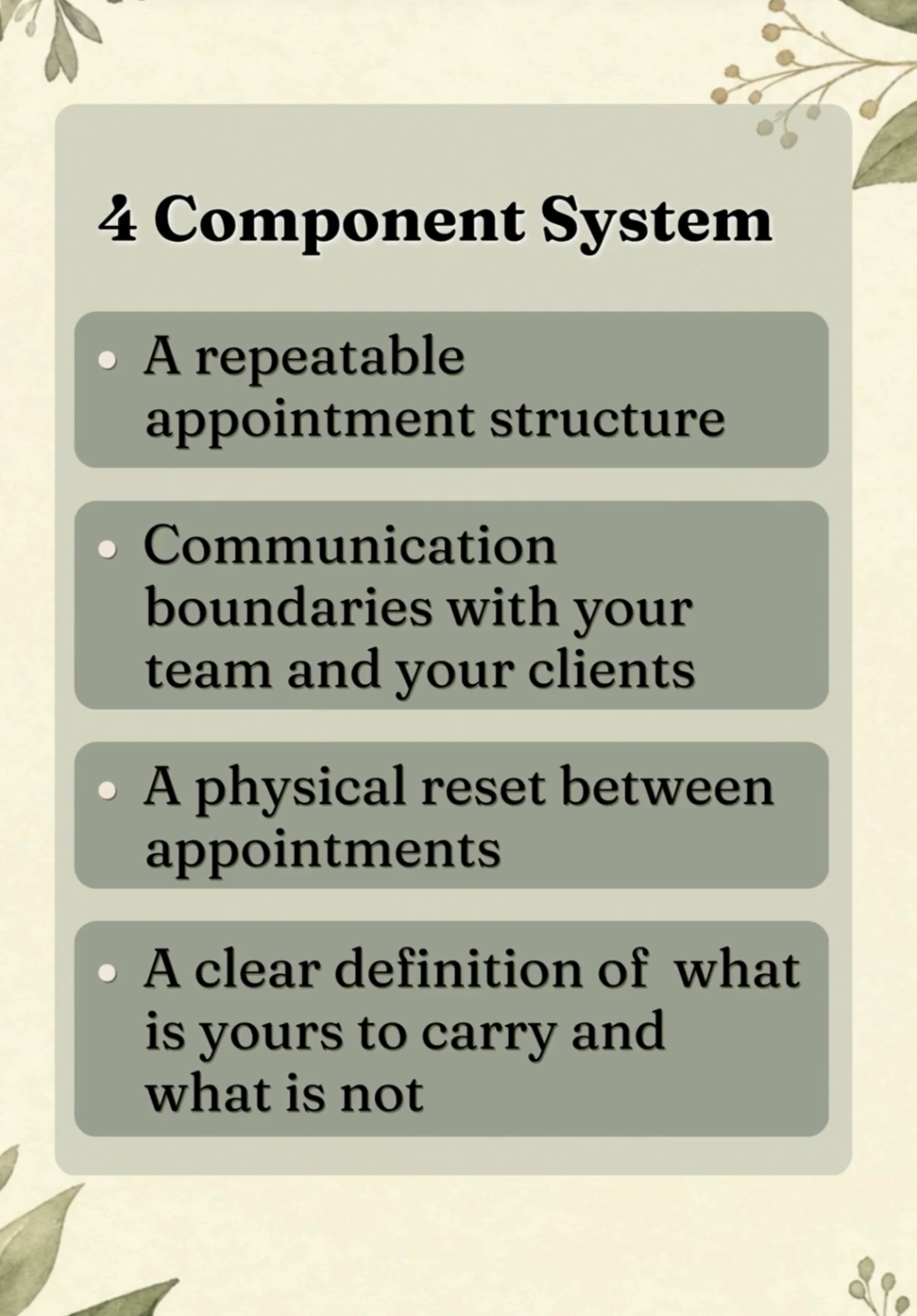
The System That Protects Your Energy
The vets who end the day with energy left over are not tougher than you. They are not built differently, and they do not care less about their patients.
They have a system that protects their cognitive budget.
- A Repeatable Appointment Structure: You are not reinventing the process in every room. You have a map that you follow every single time.
- Communication Boundaries: You establish clear boundaries with your team and your clients so that you control the flow of the appointment, rather than letting the appointment control you.
- A Physical Reset Between Appointments: You use a biological switch to reset your nervous system so that you do not carry the stress from one room into the next.
- A Clear Definition of Responsibility: You know exactly what is yours to carry and what belongs to the client, the patient, and the biology.
When you build this system, you stop white-knuckling your way through the day. You protect your ability to think clearly, communicate effectively, and actually enjoy the work you trained so hard to do.

Dr. Melissa Magnuson, DVM
Founder of The Conscious Vet and Conscious Vet Pro, owner of three AAHA-accredited hospitals in New Hampshire, and creator of the Conscious Care™ system. A Director of AAHA and AVMA speaker, she has spent 28 years in practice mentoring more than 30 veterinarians and currently works directly with 17 vets on clinical decision-making, exam room communication, and leadership.
Want the toolkit that helps you show up with more clarity and confidence in the exam room?
Get The Overwhelm Exit